
New platform to create AI agents available to all public healthcare professionals
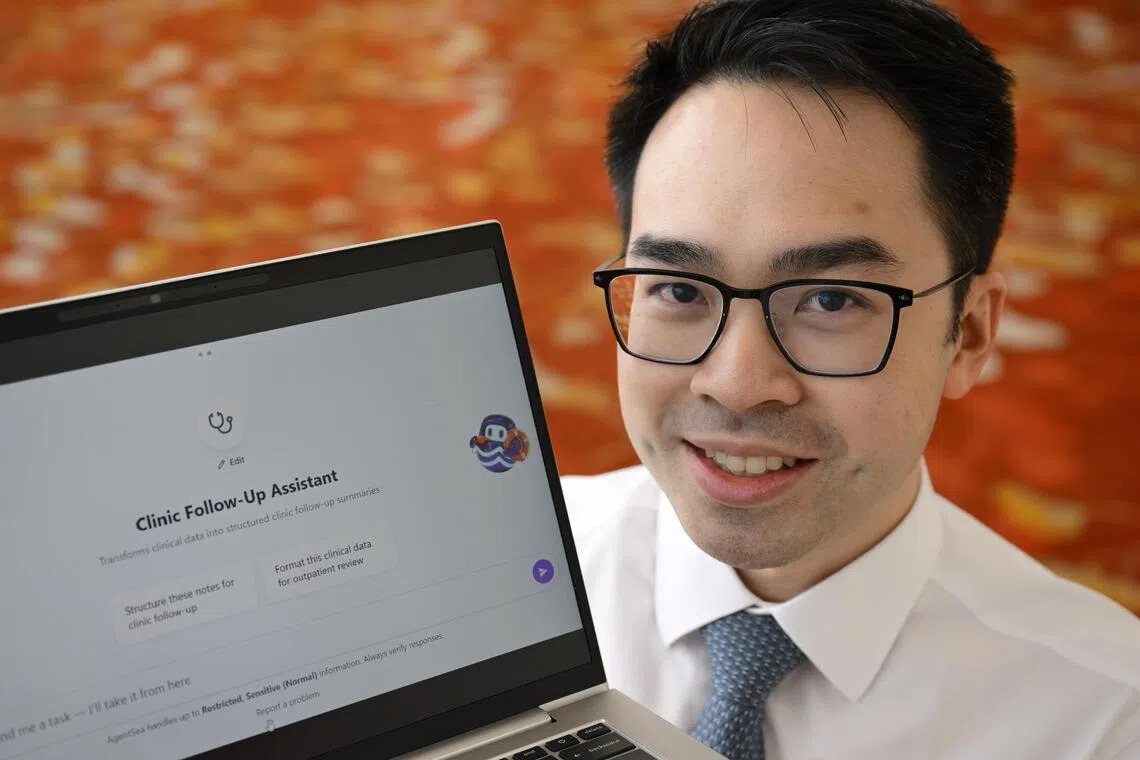
Cardiologist Kenneth Chew with a clinical assistant tool he developed using AgentSea, an agentic AI platform by Synapxe. (ST PHOTO: NG SOR LUAN)
Source: The Straits Times
Cardiologist Kenneth Chew starts his day by instructing an artificial intelligence tool he created to come up with summarised patient notes for consultations.
This work of reviewing patient histories and consolidating records before patient consultations – known as pre-clerking – used to take 40 minutes or more per day for up to 20 patients. It involved manually reviewing large volumes of patient records and complex clinical histories, summarising them for each consultation.
But since late May, the consultant with the National Heart Centre Singapore’s (NHCS) cardiology department has been relying on his AI helper, halving the time it used to take.
It was created using AgentSea, a new agentic AI platform by national healthtech agency Synapxe. Agentic AI refers to systems that can perform tasks autonomously, without human intervention.
Given the sensitivity of patient information, Chew – who has no coding experience – was concerned that commercially available models would not protect patient privacy. Guardrails within AgentSea better protect such data, he said.
The tool has allowed him to spend less time and effort on pre-clerking, and more time with his patients, Chew said.
“This has not replaced the need for verification or my own clinical assessment, but has made my preparation more efficient, allowing me to focus on delivering more personalised care during consultations,” he said.
Co-developed with Amazon Web Services, AgentSea is available to the more than 80,000 healthcare professionals in Singapore’s public health sector, allowing them to create customised AI agents that can support them in daily tasks such as procurement reviews or report preparation. This can be done using natural language, with little or no technical expertise required.
At KK Women’s and Children’s Hospital, AgentSea was used to create an AI agent that generates daily rosters, reducing the need for extensive data entry and the risk of transcription errors that came with manually preparing rosters.
In February, Prime Minister Lawrence Wong identified healthcare as one of the Republic’s four national AI missions.
Earlier Synapxe AI initiatives included Healix, a comprehensive cloud-based analytics platform, and AimSG, an AI-enabled medical imaging platform.
Synapxe chief data officer Andy Ta described AgentSea as a “significant step forward” in the journey to use AI to transform public healthcare.
“By empowering our healthcare professionals with practical AI capabilities, we enable them to simplify time-consuming tasks and spend more time on patient care, collaboration and other areas where their expertise matters most,” said Ta, who is also the agency’s director of data, AI and innovation.
Speaking at the Healthcare Information and Management Systems Society (HIMSS) 2026 APAC Conference, Senior Minister of State for Health Tan Kiat How said the response to AgentSea had been encouraging.
Since its launch at the end of May, more than 12,000 AI agents have already been created by healthcare professionals exploring how such agents can support their daily work, he said on Aug 24.
Of these, more than 300 have been made available to other users, allowing them to reuse and adapt these tools for their own purposes.
Synapxe said that its platform incorporates security and data protection safeguards to ensure sensitive information remains protected. These include rejecting requests for sensitive information such as credit card details or personal identification numbers.
Tan, who is also Senior Minister of State for Digital Development and Information, said that as AI is given more agency, safeguards around the technology must also be strengthened.
He noted that the Ministry of Health had recently updated its Artificial Intelligence in Healthcare Guidelines, setting out responsibilities for developers, institutions and healthcare professionals.
These include evaluating safety and performance, monitoring systems after deployment and maintaining incident-reporting processes, he said, adding this will ensure that professional judgment remains with people.
“This is not about choosing safety instead of innovation. Good assurance is what allows innovation to scale. Technological capability cannot be allowed to outpace our capability to govern it,” said Tan.
The event, held at the Sands Expo and Convention Centre, also saw the signing of an agreement for the HIMSS AI Outcomes Framework.
The initiative brings together healthcare institutions from Singapore, South Korea and Taiwan – including SingHealth, the National University Hospital, the Seoul National University Bundang Hospital and the Taichung Veterans General Hospital – to set up an evidence-based framework for measuring the impact and value of AI solutions.