
Singapore and Malaysia share vision for ASEAN to become green energy powerhouse: President Tharman
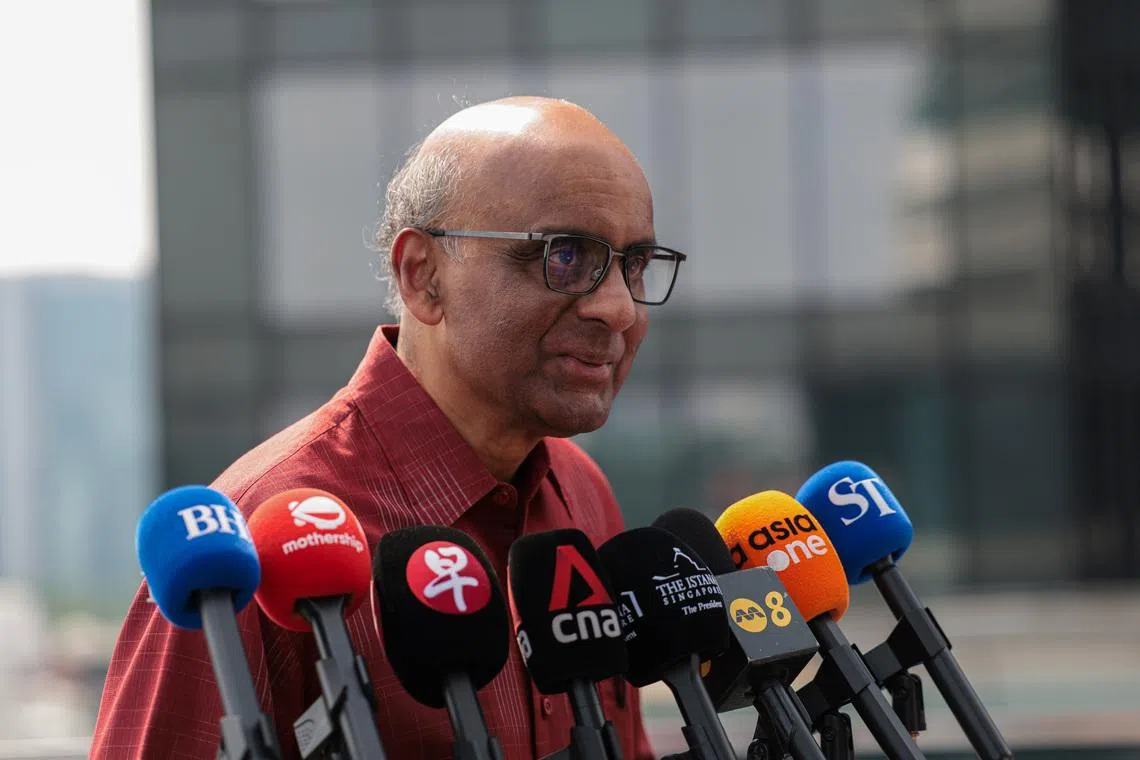
President Tharman Shanmugaratnam said ASEAN’s member states can join forces on green energy, processing power, in terms of the capacity for data centres, and the digital economy. (PHOTO: LIANHE ZAOBAO)
Source: The Straits Times
Singapore and Malaysia are “leaning forward” on ASEAN matters and share a vision for the regional grouping to become a powerhouse for green energy and data centres, said President Tharman Shanmugaratnam on July 15.
Speaking at an interview with Singapore media on the last day of his state visit to Malaysia, he thanked Malaysian King, Sultan Ibrahim Iskandar, for his invitation and said there was “a good meeting of minds” on bilateral cooperation, on ASEAN, as well as on international issues during his discussions with the Malaysian ruler, leaders and business chiefs.
In particular, Singapore and Malaysia are raising their level of ambition on ASEAN, which both sides believe has the potential to go beyond the traditional approaches of strengthening the internal market.
For instance, ASEAN’s member states can join forces on green energy, processing power, in terms of the capacity for data centres, and the digital economy, President Tharman said.
This is in the national interest of each member state, and will make the regional grouping’s value proposition much stronger in a world that is getting more fragmented, he added.
“So we have very similar thinking on ASEAN, and Malaysia is keen to work closely with Singapore on regional initiatives as we take on the chairmanship of ASEAN next year,” he said.
Singapore is slated to assume the chairmanship of ASEAN in 2027, taking over from the Philippines.
On international issues, President Tharman said Singapore and Malaysia are also in agreement about the Malacca and Singapore straits.
In particular, both countries agree on the criticality of abiding by the United Nations Convention on the Law of the Sea that ensures safe transit through straits used for international navigation, without tolls or fees, he said.
Both countries are keen to promote the way the Malacca and Singapore straits are managed, he added.
Elaborating, he said the three littoral states – Indonesia, Malaysia and Singapore – manage the waterways cooperatively, not by charging tolls or fees, but by working with user states as well as the industry through voluntary contributions to support the safety of navigation and environmental protection.
“It has worked well and is an example of how littoral states can manage international waterways in ways that are win-win for all users and, importantly, abide by the law of the sea,” said the President.
With about a quarter of global trade passing through ASEAN, Singapore and Malaysia are also keen on opening up markets for global trade and investment and further diversifying trading links, individually and as a region.
At the same time, both sides want to “avoid, at all costs, being forced by geopolitics into either a US-led bloc or China-led bloc”, he said.
“We have to engage with each of the major powers, and grow our links with other regions of the world.”
On a broader level, President Tharman said both countries are strengthening and maturing their economic complementarity.
He cited how the linking up of Johor and Singapore through the Johor-Singapore Special Economic Zone and the Rapid Transit System may cause some businesses and service industries in Singapore to lose out.
“But others will gain, and on the whole, both countries will be winners,” he said.
“We have to accept that, with the larger win, there will be some losses. And that is a mature way of thinking about the bilateral relationship, on both sides.”
He said he had good meetings during his visit with Sultan Ibrahim, Malaysian Prime Minister Anwar Ibrahim, Selangor Sultan Sharafuddin Idris Shah, Selangor Chief Minister Amirudin Shari, as well as business leaders.
The President added that his visit comes quick on the heels of other high-level visits, such as Prime Minister Lawrence Wong’s visit to Kuala Lumpur in February for the breaking of fast with Datuk Seri Anwar during Ramadan, and Senior Minister Lee Hsien Loong’s visit to Pahang and Terengganu in May.
Noting that the leaders of both sides are investing a lot in the bilateral relationship, he said: “These visits are not just matters of form, and my state visit is not just about reciprocating the previous visit by Sultan Ibrahim as King of Malaysia.
“We each take a personal interest in the bilateral relationship between Singapore and Malaysia – wanting to understand each other’s thinking and to push cooperation along where possible.”
He added that this is being done at all levels.
He said he had a lengthy meeting in Selangor discussing with the Sultan issues such as flood mitigation and how Singapore gradually changed the mindset of parents on vocational education, among other things.
He added that he also had a very constructive meeting with Amirudin, who is keen to advance the economic relationship between Singapore and Selangor through collaboration on the start-up ecosystem.
Recounting a trip to Malaysia in 2009 that he took with Minister Mentor Lee Kuan Yew, President Tharman said MM Lee had visited not just Kuala Lumpur, Perak and Pahang, but also Penang and Kelantan, which were under opposition governments.
“We have to keep that up – understanding the thinking and priorities in each state, and finding things we can do together across the span of the peninsula and East Malaysia,” he said, of the need to work with the leaders of the different states.
“It is complementary to the broader relationship between the two governments, and helps ensure that the relationship between the two countries is robust, and that we understand each other well across the board and do not have misconceptions.”
In the longer term, President Tharman said more can be done to promote a deep, enduring understanding between the next generations of Singaporeans and Malaysians.
“If we take a long view, I would say that there is more we have to do to bring our youth together in a more sustained way, and to deepen cultural exchanges,” he said.
He suggested introducing joint studies or extended internships or entrepreneurship programmes in a few schools and universities, which will allow students from both sides to have a more prolonged immersion so that they can develop friendships.
“There is nothing like living together, studying together, and hanging around together over a longer period, or repeated periods, that makes for lasting friendships and a more enduring understanding of each other,” he added.
Acknowledging that it may not be easy to arrange, the President said it may require schools on both sides to give credits to those in the programmes.
But he added that there would be larger strategic benefits in time.
“We cannot recreate what it was like in the old days – when young people literally grew up together, went to the same schools, and had family moving up and down the peninsula,” he said.
“But I think we can find a way to enable more prolonged immersion, so you get the natural development of friendships among our students.”