
Singapore's new maritime master plan to focus on capacity, technology, upskilling; work on Tuas Port Phase 2 begins
November 20, 2026
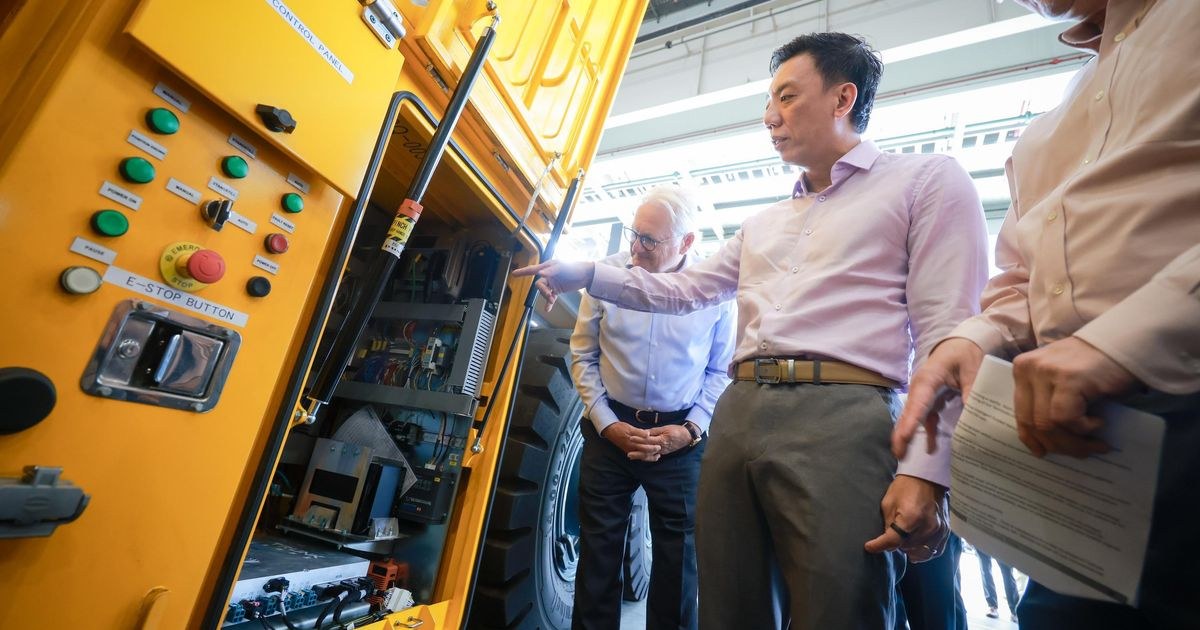
Transport Minister Jeffrey Siow viewing an intelligent guided vehicle at Tuas Port. PHOTO: ST
Source: The Business Times
Singapore’s new maritime master plan will focus on expanding capacity across its port and maritime ecosystem, leveraging technology and innovation, and investing in its people, said Transport Minister Jeffrey Siow on Friday (Nov 20).
He listed these three priorities of the in dustry blueprint that will be unveiled in April, giving a preview of the master plan in his speech at the ground-breaking ceremo ny of PSA Singapore’s Tuas Port phase two.
Referring to the “finger” of the Tuas port to be developed under this phase, Siow said that the infrastructure will enable Singapore to handle the largest container vessels.
It is the largest of the four fingers and s pans nearly 400 hectares of reclaimed land. It will commence operations in two years’ time, with 2 1 deepwater berths in use by the middle of the next decade.
When Tuas Port is fully completed in the 2040s, it will have 66 mega berths and be capable of handling 65 million 20-foot equivalent units (TEUs) of containers a year.
It has handled 25 million TEUs2 5 million TEUs as at August since operations started in September 2022.
A TEU, which represents the volume of a standard 20-foot-long shipping container, is a standard unit of measurement used in the shipping and logistics industry to de scribe the cargo capacity of container ships.
Singapore handled 44.5 million TEUs in 2025, with PSA Singapore being the operator of the world’s l argest container transhipment hub.
The city-state will go beyond raising capacity to improving reliability and value. The m inister pointed out that shipping lines can count on Singapore for a fast turnaround or even to make up for delays elsewhere along their routes.
Cargo owners can tap Singapore to store, process, consolidate and distribute goods into regional markets, Siow added. He noted that PSA’s new supply chain hub anchors its logistics and warehousing functions directly alongside the port.
Singapore will strengthen its position as a global maritime capital, said Siow, who is also second minister for finance.
The maritime hub strives to evolve from being a focal point for firms to a hub of flows as well as to attract more maritime companies – including those providing auxiliary services – to set up their global and regional headquarters here.
This is so that more commercial decisions and transactio ns behind global shipping are made from Singapore.
“Our ambition is for Singapore to be where global trade flows are orchestrated and managed, and where the highest value can be created,” said Siow.
“Success to us is not measured just in container vol umes. It is seen and felt in the global re ach of our companies, the strength of our ecosystem, and most importantly, the good jobs it creates for Singaporeans.”
Technology and upskilling
On harnessing technology and innovation, Siow pointed out that Tuas Port was designed as a fully automated port to improve productivity.
The facility will deploy around 1,000 intelligent guided vehicles in phase two. These vehicles are not boun d to fixed routes but will optimise their own routes to adjust to the traffic while operating alongside manned port vehicles.
At the anchora ges, drones that ferry supplies from shore to ship are being trialled, replacing the use of boats to do the work.
The goal is for artific ial intelligence, digital twins, autonomous systems and real-time data to enable the entire port to operate as one integrated system, Siow added.
As the port evolves , workers will have to evolve with it because Singapore cannot afford to freeze time or preserve old workflows in a highly competitive world.
The city-state will invest even more in its people to upskill them so that they will be able to enjoy better pay and safer workplaces.
“We want Singapore to be the port of choice for global shipping, and to be a hub of flows where global maritime trade is managed and shaped. A place where businesses create greater value, and where Singaporeans will enjoy better jobs and opportunities,” said Siow.