
S’pore upgrades key exports forecast for 2026 after AI-powered 27.4% jump in Q2
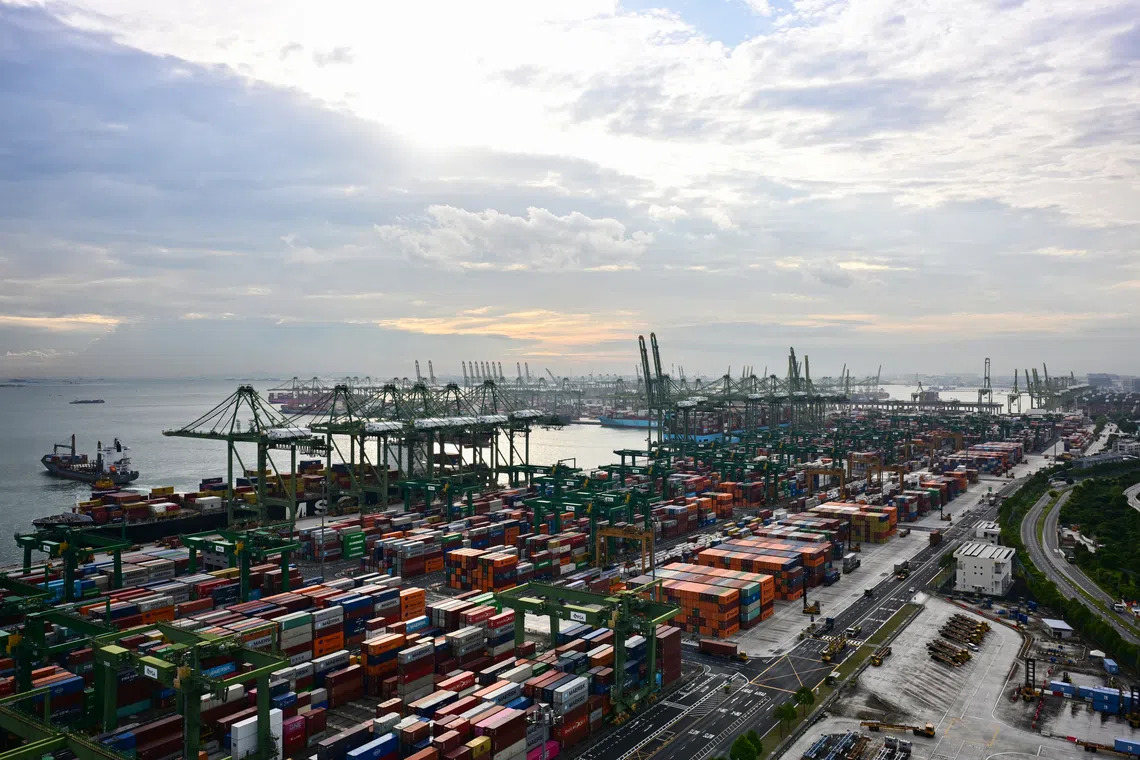
Electronics shipments in the April to June period surged by 88.1 per cent year on year. (ST PHOTO: LIM YAOHUI)
Source: The Straits Times
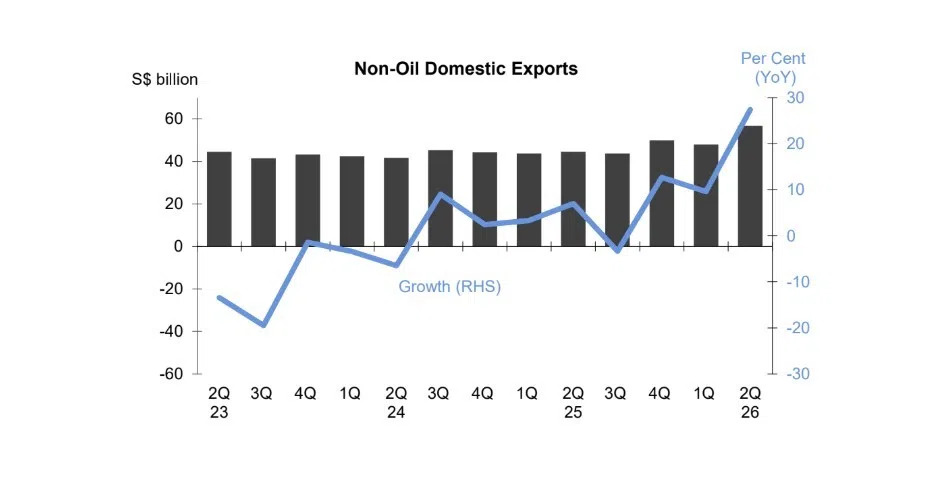
Singapore upgraded its full-year non-oil domestic exports (NODX) forecast after a 27.4 per cent surge in the second quarter of 2026 – led by demand for its electronic goods from the global AI infrastructure build-out.
NODX in the first quarter grew by 9.6 per cent, said Enterprise Singapore (EnterpriseSG) on Aug 11.
The government agency upgraded its NODX forecast for 2026 to 14 per cent to 16 per cent, up from an earlier forecast of 3 per cent to 5 per cent, reflecting the exceptionally strong first-half performance, led by electronics.
The first-half surge in shipments came in at a surprisingly high 18.6 per cent, the strongest growth since 2010, EnterpriseSG said.
Electronics shipments in the April to June period surged by a record 88.1 per cent year on year, following growth of 57.8 per cent in the first three months of 2026.
Within the electronics segment, shipments of integrated circuits, or semiconductors, surged by 91.9 per cent, while disk media exports soared by 182.5 per cent.
Demand for semiconductors and electronic devices needed to power artificial intelligence workloads at data centres worldwide has boomed in 2026, helping economies across Asia, including Singapore, mitigate the negative impacts of the Iran war and US trade tariffs.
The strength of the AI-powered export demand has resulted in a surge in Singapore’s manufacturing output, pushing overall economic growth to an average of 6.1 per cent in the first six months of 2026.
The Ministry of Trade and Industry (MTI) on Aug 11 upgraded its gross domestic product growth forecast for 2026 to 4.5 per cent to 5.5 per cent, from the previous range of 2 per cent to 4 per cent, reflecting the better-than-expected performance of the economy in the first half, as well as an improved outlook due to the acceleration in global AI-related capital expenditure.
Still, there are worries about the impact of financial market volatility on AI infrastructure spending.
MTI warned that sudden risk-off sentiment regarding global AI-related capital spending could trigger sharp market corrections, with potential spillovers to broader economic activity.
A Monetary Authority of Singapore survey of private forecasters in June showed 60 per cent of respondents flagged an AI bubble burst as a downside risk for the economy, with 15 per cent citing it as their top concern.
However, EnterpriseSG said export growth in the second half is likely to remain supported by the AI build-out, even as the expansion moderates in percentage terms due to base effects.
Still, the agency said that downside risks to exports include scenarios such as a more prolonged conflict in the Middle East and higher tariffs imposed by the US.
Singapore’s non-electronics NODX grew by 8 per cent in the second quarter, after contracting in the previous quarter by 3.5 per cent. A 62.3 per cent rise in pharmaceutical shipments led the non-electronics exports.
Total merchandise trade – which includes re-exports – expanded by 40.2 per cent in the second quarter, with both exports and imports rising.
Total exports were up by 38.5 per cent, better than the 27.9 per cent growth in the previous three-month period. Non-oil exports rose 36.5 per cent, while oil exports were up 50.8 per cent.
Singapore’s top market for NODX shipments in the second quarter was Taiwan, which saw a 90.4 per cent jump. That was followed by a 67.1 per cent rise in shipments to South Korea and a 58.9 per cent increase to the United States.